Budget and prices
What a working home office costs in Canada, line by line
Six items, the tax the till adds, the years you keep each one, and the electricity. An example $1,530 kit costs $246.99 a year spread over seven years.

A home office is bought as six separate purchases and then regretted as one total. Putting the six on a single page first, with the sales tax that gets added at the counter, makes the trade-offs visible before anything is ordered.
This guide builds the figure in four steps: the kit, the till, the years, and the electricity. The prices are examples chosen to make the arithmetic readable; this site carries no price feed and quotes nothing.
Six lines, one total
Take an example kit: a desk at $400, a chair at $550, a monitor at $320, a monitor arm at $90, a keyboard and mouse at $110, and a task lamp at $60. That totals $1,530 before tax, and the chair is the largest line at 36% of it.
The chair being the largest line is the usual result and the usual surprise. It is also the item kept longest, which is why the per-year arithmetic further down matters more than the sticker comparison.
Two of the six can be deferred without affecting the others. The arm and the lamp together are $150, or 10% of the kit, and they can be added in month three once you know where the glare actually falls. The desk, chair and monitor cannot be deferred, because they determine each other's dimensions.
| Item | Example price | Share of $1,530 | Typical years kept |
|---|---|---|---|
| Chair | $550 | 36% | 10 years |
| Desk | $400 | 26% | 10 years |
| Monitor | $320 | 21% | 7 years |
| Keyboard and mouse | $110 | 7% | 5 years |
| Monitor arm | $90 | 6% | 10 years |
| Task lamp | $60 | 4% | 10 years |
| Total | $1,530 | 100% | — |
Prices are illustrations used to show the divisions, not quotes. The years column is a planning assumption; the only one with a hard technical limit is the monitor.
The till adds between $76.50 and $229.50
Canadian shelf prices are pre-tax, because the rate belongs to the province of supply. The federal GST is 5% everywhere; five provinces harmonize their share into a single rate and four charge a separate provincial tax alongside it.
The Canada Revenue Agency publishes the combinations: 13% in Ontario, 14% in Nova Scotia since 1 April 2025, and 15% in New Brunswick, Newfoundland and Labrador, and Prince Edward Island. Saskatchewan adds 6%, British Columbia and Manitoba add 7%, and Quebec adds a 9.975% QST, each alongside the 5% GST.
On $1,530 of furniture and equipment, that is a $153 difference between the cheapest and most expensive counter in the country — about the price of the arm and the lamp together.
| Where you buy | Rate applied | Tax on $1,530 | Total at the till |
|---|---|---|---|
| Alberta, NT, NU, YT | 5% GST | $76.50 | $1,606.50 |
| Saskatchewan | 5% GST + 6% PST | $168.30 | $1,698.30 |
| British Columbia, Manitoba | 5% GST + 7% PST | $183.60 | $1,713.60 |
| Ontario | 13% HST | $198.90 | $1,728.90 |
| Nova Scotia | 14% HST | $214.20 | $1,744.20 |
| Quebec | 5% GST + 9.975% QST | $229.12 | $1,759.12 |
| New Brunswick, NL, PEI | 15% HST | $229.50 | $1,759.50 |
Tax column is $1,530 multiplied by the combined rate; total is $1,530 plus that figure. The rest of this guide uses the Ontario total of $1,728.90.
Divide by the years you will keep each item
Using the Ontario total of $1,728.90: over 3 years that is $576.30 a year, over 5 years $345.78, and over 7 years $246.99. The kit did not change between those lines; only the horizon did.
Averaging the whole kit over one horizon is a simplification, because the chair and desk outlast the keyboard by years. The more honest version divides each item by its own expected life, which lowers the total and shows where replacement spending will actually land.
Done that way the example kit costs $200.82 a year. The gap between that and the blunt seven-year figure of $246.99 is the clearest argument for buying a chair and desk you will still want in year ten, rather than ones you will replace in year four.
| Method | Arithmetic | Cost per year |
|---|---|---|
| Whole kit over 3 years | $1,728.90 divided by 3 | $576.30 |
| Whole kit over 5 years | $1,728.90 divided by 5 | $345.78 |
| Whole kit over 7 years | $1,728.90 divided by 7 | $246.99 |
| Each item over its own life | Chair, desk, arm, lamp over 10 years; monitor over 7; keyboard and mouse over 5 | $200.82 |
The last row divides each tax-inclusive item price by its own years: chair $62.15, desk $45.20, monitor $51.66, keyboard and mouse $24.86, arm $10.17 and lamp $6.78, rounded at the end. The years are planning assumptions.
Running cost is about $14.52 a year
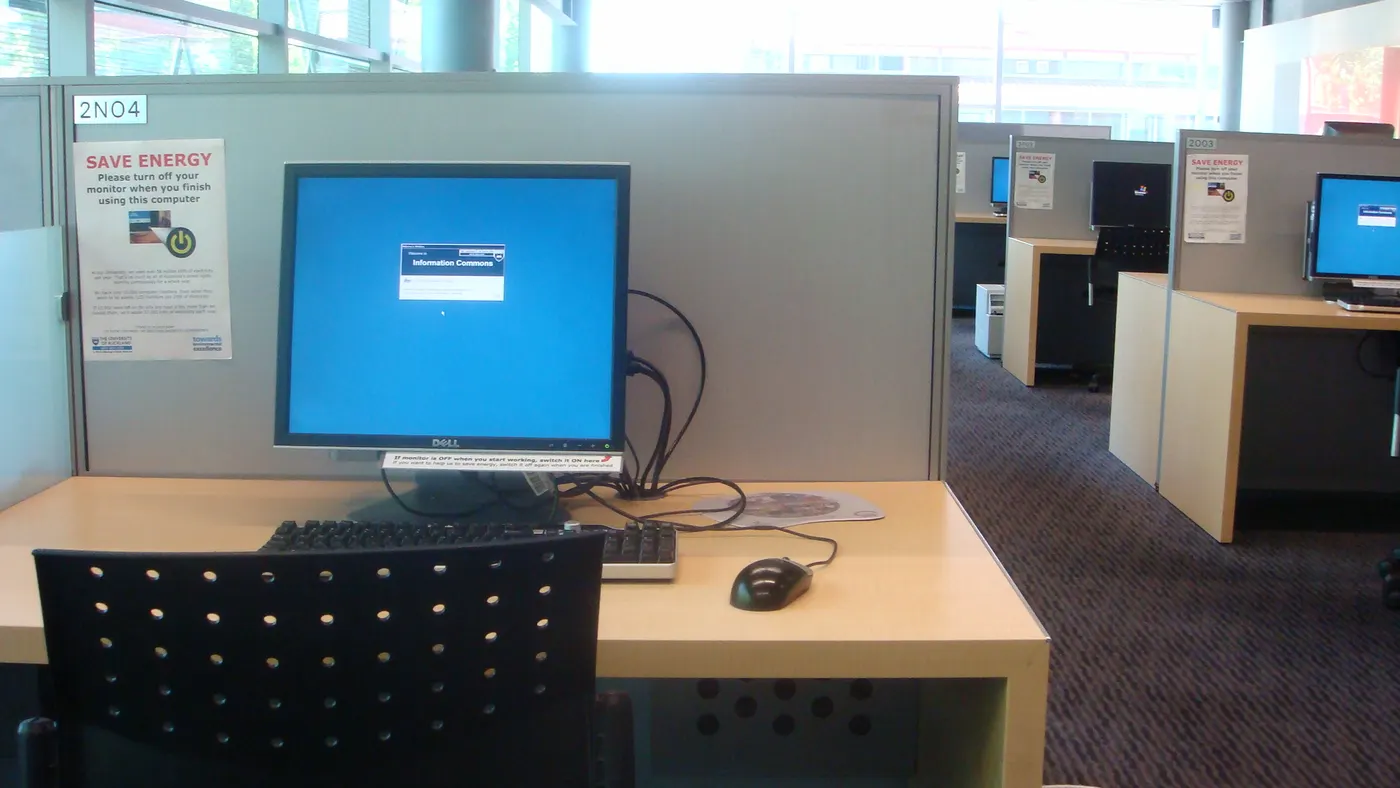
A monitor drawing 25 watts and a laptop drawing 30 watts, run 8 hours a day for 220 working days, consume 96.8 kWh a year between them. At an assumed 15 cents per kWh that is $14.52, or about 6% of the seven-year annual figure for the kit itself.
Rates are the only part worth personalising. The Canada Energy Regulator's residential electricity bill report sets out each jurisdiction's structure, with energy charges from 8.740 cents per kWh in Manitoba to 58.56 cents per kWh in Nunavut; those figures come from 2019 and 2020 filings, so your own bill is better.
Efficiency certification barely moves this line. Natural Resources Canada puts the average saving for an ENERGY STAR certified monitor at 7% against a standard model. The monitor's own share of the 96.8 kWh is 44 kWh and $6.60 a year, so 7% of it is about $0.46 a year. The certification is a tie-breaker, not a payback.
| Equipment | kWh per year | At 15 cents per kWh |
|---|---|---|
| Monitor at 25 W | 44.0 kWh | $6.60 |
| Laptop at 30 W | 52.8 kWh | $7.92 |
| Both together | 96.8 kWh | $14.52 |
| Both, left on 24 hours a day all year | 481.8 kWh | $72.27 |
Each row is watts multiplied by hours, by days, divided by 1,000. The 220 working days and the 15 cent rate are assumptions; a plug-in meter and your own bill replace both.
The number this kit is actually competing with
Statistics Canada reported an average commute of 26.7 minutes each way in May 2025, with public transit commutes averaging 44.1 minutes and Toronto the longest at 34.9 minutes. At 26.7 minutes each way over 220 working days, that is 11,748 minutes, or about 196 hours a year.
Against the example kit's $246.99 a year over seven years, that is $1.26 an hour of commuting removed. The comparison is not exact — a home desk does not remove every commute, and the same release records 17.4% of workers as working mostly from home in May 2025 — but it is the right order of magnitude for a decision that usually gets made on the sticker alone.
Sale prices deserve the usual check. The Competition Bureau's guidance on deceptive marketing practices says a regular price should not be advertised unless the product has been offered in good faith at that price for a substantial period, or a substantial volume has been sold at it. Office furniture is sold on a permanent discount calendar, which is exactly the circumstance that rule exists for.
Before you buy
- List the six items separately with a price against each before buying anything
- Add your own province's combined rate to get the till price
- Divide each item by the years you expect to keep it, not the kit by one number
- Decide which two items can wait until month three
- Read the rated power from the monitor's own plate for the electricity line
- Use your own electricity rate from a bill rather than a national average
- Check whether an advertised regular price has genuinely been a selling price
Questions readers ask
- Which of the six items is worth spending the most on?
- The chair, on these figures, because it is both the largest line at 36% of the kit and the item with the longest life. Divided over 10 years its tax-inclusive share is $62.15 a year. A chair replaced after 3 years instead costs $207.17 a year, which is more than the entire rest of the kit.
- Can I claim any of this on a Canadian tax return?
- That depends on whether you are an employee with a signed employer declaration or self-employed, and on the rules in force for the tax year in question. The figures in this guide are purchase costs before any deduction, and the Canada Revenue Agency publishes the current employment expense rules each year on its own site.
- Is a sit-stand desk worth the extra over a fixed one?
- Price it per year rather than per desk. An extra $400 on a desk kept 10 years is $40 a year before tax, which is less than the electricity line. Whether it earns that depends on whether you actually alternate; the setup guide on this site covers the schedules the Canadian Centre for Occupational Health and Safety describes.
- Does buying everything at once save money?
- Only on delivery. What it does cost is flexibility: the arm and the lamp together are $150, or 10% of the kit, and both are better bought in month three once you know where the glare falls and how far the screen needs to sit. The desk, chair and monitor do have to be bought together, because each one constrains the others' dimensions.
- How much does leaving everything on overnight cost?
- On this guide's figures, running the monitor and laptop 8 hours a day for 220 days is 96.8 kWh and $14.52 a year at the assumed 15 cent rate. Leaving both on 24 hours a day all year is 481.8 kWh and $72.27. The $57.75 difference is roughly the price of the task lamp, every year.
Sources
- Canada Revenue Agency — GST/HST calculator and current rates by province and territory — checked 2026-11-03
- Statistics Canada — The Daily, number of Canadian commuters increases for fourth straight year in 2025 (26.7-minute average commute; 17.4% working mostly from home) — checked 2026-11-03
- Natural Resources Canada — ENERGY STAR certified displays and monitors (7% average saving) — checked 2026-11-03
- Canada Energy Regulator — Canadian residential electricity bill, sources and methodology — checked 2026-11-03
Some links on this site can earn us a commission. That does not change which product a guide recommends, and it adds nothing to your price. Advertising is not enabled on this site yet. When it is, ads will be labelled and kept visually separate from the guides.